The Enduring Story of
Bella Vista Country Club
Discovering the History, Hospitality, and Heart of Bella Vista Country Club
Some places hold their history in stone and scorecards. Others hold it in memory, passed hand to hand, generation to generation, until the line between guest and family blurs entirely. Bella Vista Country Club is one of the latter.
Long before it was a golf course, this ground was a gathering place. My grandparents ran the Sunset Hotel here, and though the building itself has long since given way to rubble, something that they believed in still remains: a spirit of welcome, an insistence that a place should feel less like a destination and more like a homecoming.
I did not know the hotel as they knew it. I know it the way most of us know the stories that shape us, secondhand, in fragments, told and retold until they become part of how we see a place. I don’t know the old route of the golf course and the sense of the game as it once was. But I know this: Every time I look up into the hills on the way to “The Country Club”, and every time I walk their fairways, I am walking through more than a story. I am walking through what remains of a family’s hospitality, reimagined for a new generation of players and wanderers.
This piece is written on their behalf; for two people who welcomed strangers into a home that no longer stands, on land that still, in its own way, welcomes. To the Linebarger’s who had a vision, and to all of those who took part, this is for them.
There was a year so long ago,
When guests arrived bags in tow.
Golf and fun would be the treat,
And friends around all would meet.
The Sunset Hotel famed and new,
Opened wide its doors for view.
Fairways stretched from door to sky,
Welcoming all who wandered by.
Imagine it before you imagine anything else.
The country is flush in a way it has never quite been flush before; flush with money, with movement, with the American certainty that the future is a place you drive toward and when you arrive it will be better than where you left. The stock market is climbing like it has forgotten that things that climb must eventually stop. A man with a steady business and a reliable automobile feels, in the summer of 1929, that the world is conducting itself correctly.
The motorcar is everything now. Freedom made of gravel and ambition, and a road map folded incorrectly in the passenger seat.
Imagine what it meant to leave.
A family loading a Ford on a Thursday morning before the heat settled in, luggage roped to the back, children arranged in the rear seat in negotiations that would be renegotiated every forty miles. A husband in his shirtsleeves because it is July and he is not performing for the highway. A wife in a dropped-waist dress of pale lawn cotton, wide-brimmed straw hat tilted at the angle that means she knows exactly what she is doing with a hat, gloves stuffed into her pocketbook somewhere around the Missouri line because it is July and it is hot.
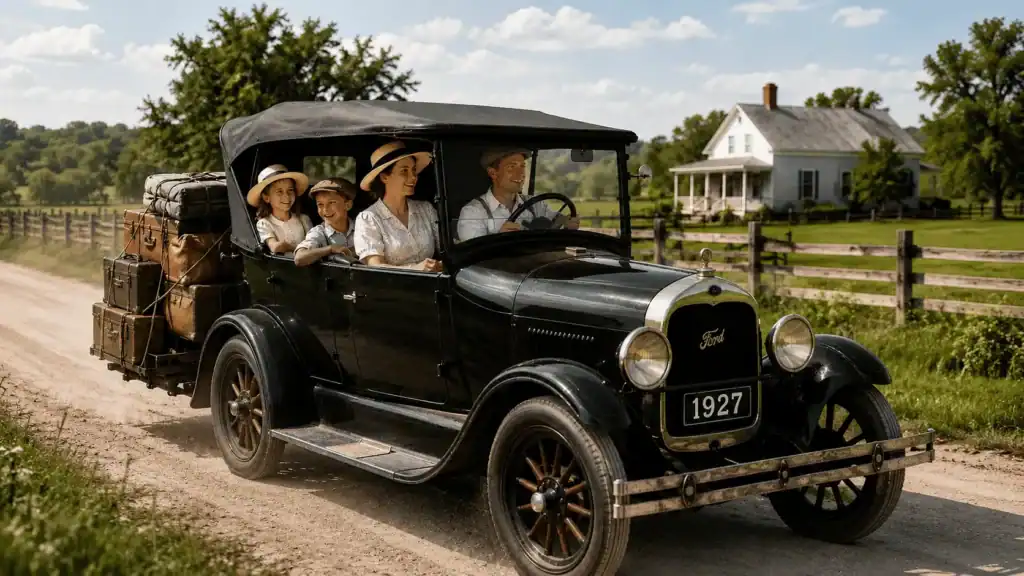
A family from Tulsa or Fort Smith or Kansas City pointing themselves toward the Ozark Mountains because a man named Linebarger had been advertising in their newspaper for a decade, and their neighbor had been three times and come back looking ten years younger, and one morning there was a circle drawn in careful ink around an advertisement:
Bella Vista. The Playground of the Ozarks.
That was the end of the reasons not to go.
Imagine the road climbing into the hills.
The air changing somewhere around the Arkansas line, losing its flatness, gaining something green and cool that smells of limestone and running water and deep shade. The children stop their negotiations and press their faces to the windows. The wife tilts her face toward the open window like a woman who has been inside too long.
Then the valley opens below; the lake, green fairways running along its banks, a dance pavilion, cabins scattered through the timber and up on the crown of West Mountain, white against the Ozark sky, the hotel. Three stories of it. Looking out over everything it helped create.
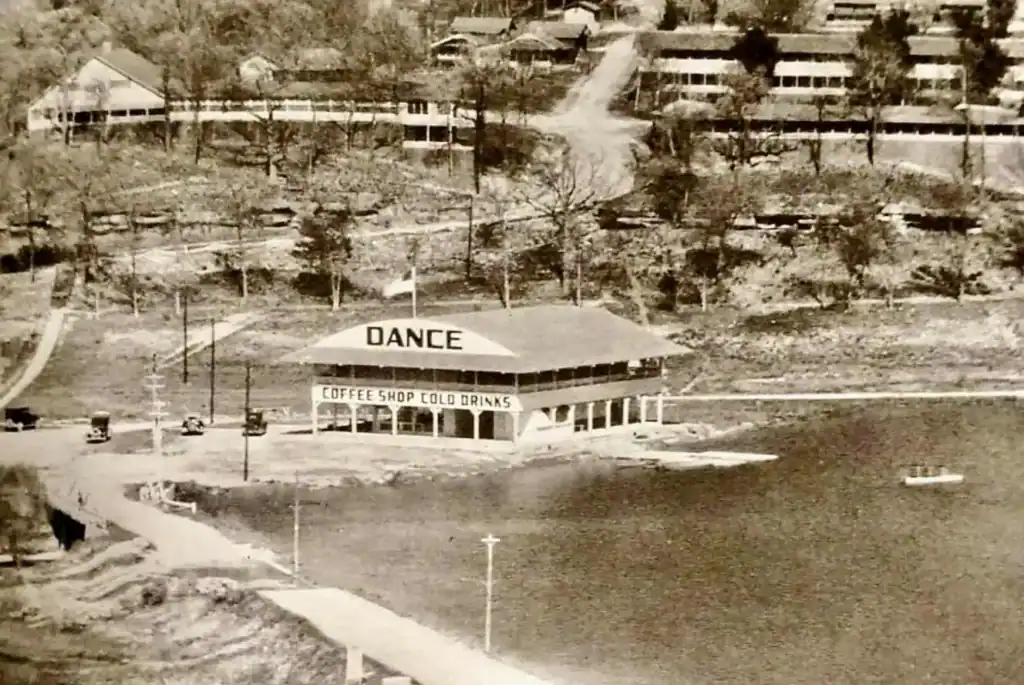
Now imagine Clarence Linebarger.
He grew up not far from this hillside. His father brought the family from Indiana in 1898 for his mother’s health, and these hills got into him the way a place gets into you when you are young enough to be shaped by it. He went to Texas, made money, built a town from raw land with his brothers Forest and Clayton. Then they came back.
By 1921 they had laid a nine-hole golf course along the banks of Lake Bella Vista, nine holes cut through Ozark timber, not grand by the standards of the great clubs, but true and necessary. Alongside swimming, golf was the resort’s primary recreational attraction. The course covered much of where U.S. 71 runs today. Men came up from their cabins every morning with bags over their shoulders and played nine holes in the mountain air while their families swam in the “plunge” and rode horses through the timber. Families came from five states, Memorial Day to Labor Day, and rarely left before they had to.
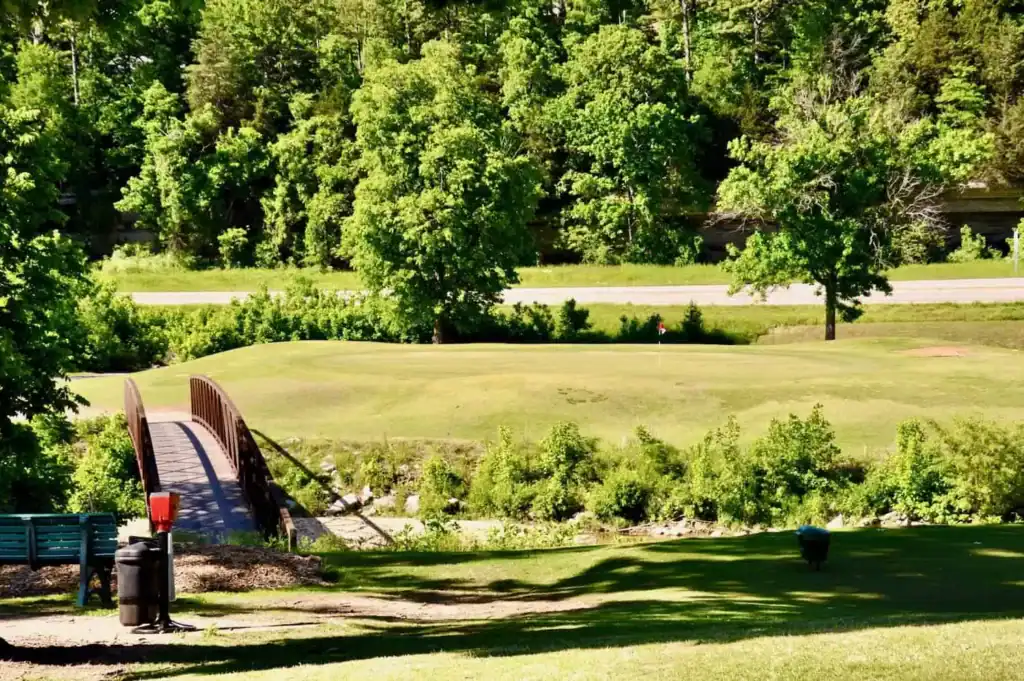
By 1927 the eastern side of the valley was thriving, and Clarence was standing on West Mountain understanding the story was not finished. Lots to sell on the western face. Buyers needed somewhere worthy to stay. This hillside above the golf course, above the lake catching the morning light, deserved something that matched it. He was going to spend a hundred thousand dollars finding out what that was.
He hired architect A.O. Clarke of Rogers, who came up the mountain with drawings of medieval towers, massive and fortress-like. Clarence looked at them, then looked at the valley below, at the families on the golf course doing exactly what he always said they would do.
These people are coming to rest, he said. Not to be impressed by towers.
What rose instead was something quieter, white weatherboarding, box columns climbing three stories on the valley-facing porch, two wings angling back like arms opened wide. Simple. Honest. The kind of building that says you are welcome here.
One hundred men built it in ninety days from Benton County oak. Sixty-five rooms, every one with a private bath, something very new in the country. A lobby with a native stone fireplace climbing to the ceiling. And in the northern wing, a dining room with a bandstand and a ten-piece orchestra hired for the season.
The Sunset Hotel opened in the summer of 1929 and the people came.
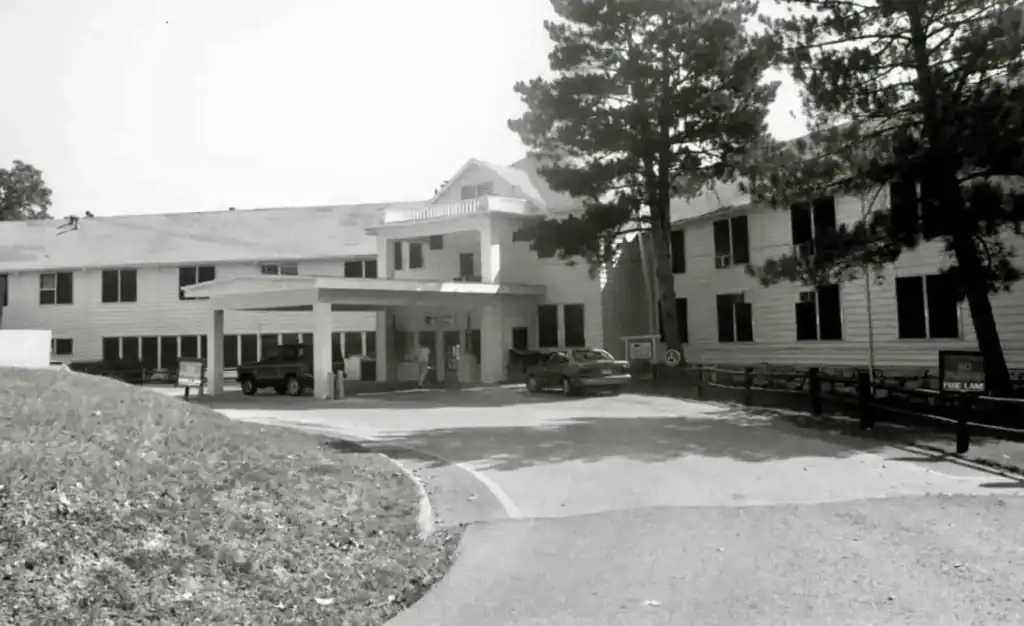
Imagine them coming.
The woman from Fort Smith in pale yellow Georgette crepe, low-heeled shoes because mountain roads and high heels are a navigation she consistently loses. Harold, her husband, a hardware man in a cream linen suit, his golf clubs in the trunk because his partner Gerald told him three times to bring them and Gerald is always right. Harold has worked six days a week for twenty years. Here he is with the windows down and the fairways visible below and something unknotting in him that has been knotted for longer than he realized.
The family from Kansas City, three children renegotiating since Joplin, going quiet all at once when the hotel appears, white on the hill above the valley. The young man from Springfield in a new suit who is unaware that he will meet his future wife at the Saturday dance.
The man behind the registration desk knows your name before you say it. He tells you your room number and mentions that the first tee time is available at seven in the morning. Harold is very interested.
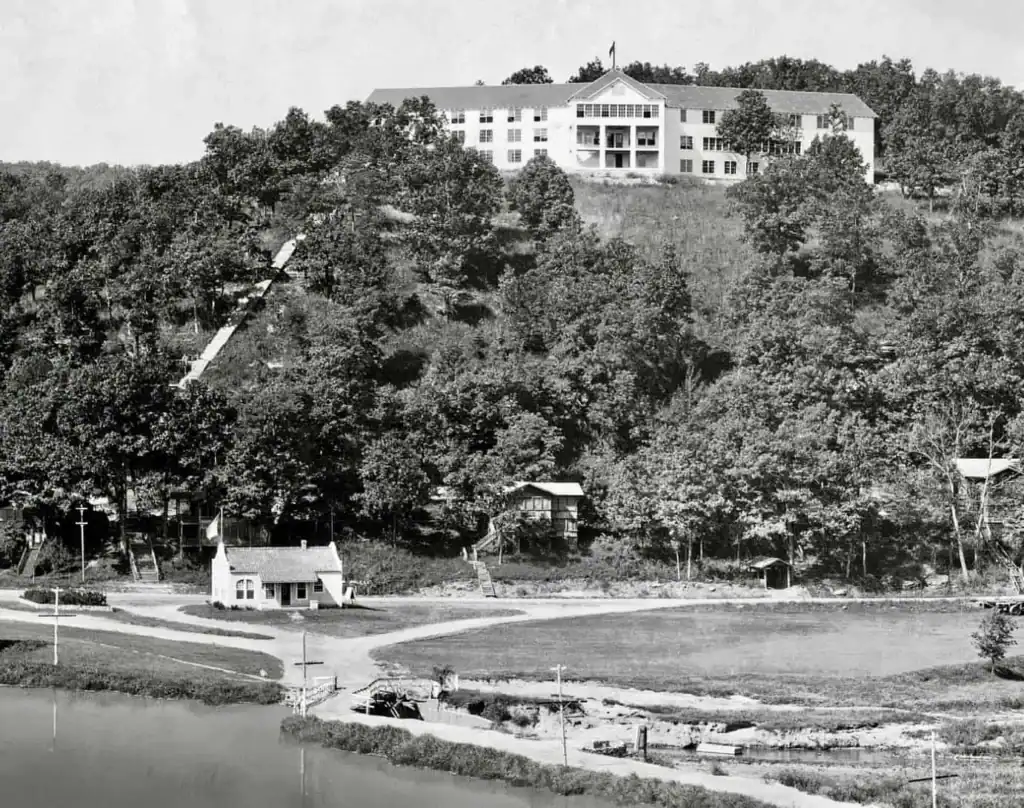
The room smells of new oak and mountain air. The windows open to the valley, the golf course green along the lake, the creek in the low distance, the flags standing easy in the summer air. The bathroom gleams with the pride of a new hotel. Hot water runs immediately. The woman from Fort Smith fills the tub and stares at the ceiling with the expression of a woman who has been entirely correct about something and is allowing herself a moment to know it.
Harold looks down at the fairways.
Tomorrow morning, he thinks. Seven o’clock.
The dining room at seven. White tablecloths. The women in their summer evening dresses. The men with the ease of men who have spent the morning on a golf course and arrived at dinner ready to be present. Then the orchestra, ten men on the bandstand, and the room shifts into what it was arranged to be. The music holds you lightly.
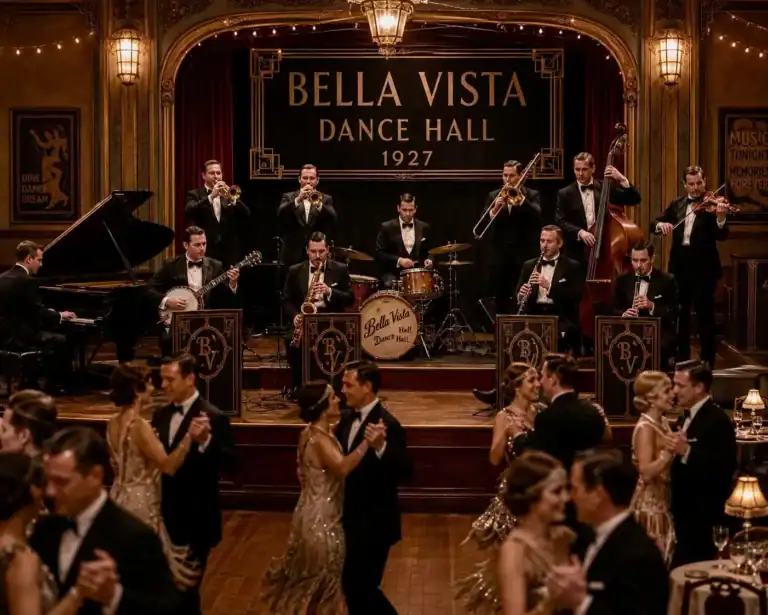
Harold asks his wife to dance.
She accepts with the composure of a woman who was not waiting at all.
Imagine the porch after midnight.
The three-story front porch facing east, sixty-five degrees, the smell of pine and limestone and the creek far below. The valley holding its scatter of cabin lights. Down there in the dark, invisible but present, nine fairways running along the lake.
I want to look at the lots tomorrow, she says. I know you do, he says. I’m serious, Harold. I know you are.
Then October came.
The market fell. The world for which the Sunset Hotel had been built began, quietly at first and then all at once, to come apart. The families still came through the thirties because the Ozarks were still the Ozarks. The golf course still ran green. The orchestra still played. But the flush was gone and the certainty was gone with it.
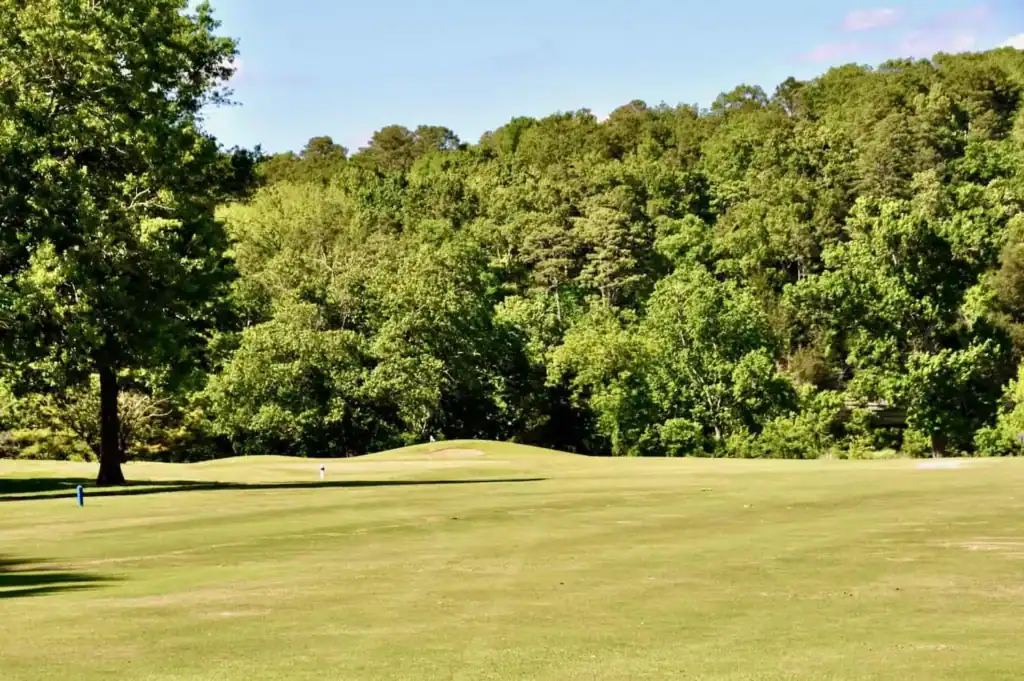
The Linebarger’s held on through the Depression and the war years, but after the war, as the economy improved, more people were buying automobiles and wanting to travel instead of spending the whole summer in one place, so business did not pick up the way they had hoped. They sold in 1952. The hotel changed hands, became a school, then sat empty. The nine-hole golf course, those fairways along the lake since 1921, quietly disappeared, absorbed back into the ground, covered eventually by the highway that now runs where the fairways once ran.
The old hotel stood on its mountain and waited.
For a time.
Imagine John A. Cooper Sr. in 1963.
A developer and an avid golfer, which is not a coincidence, he had already built Cherokee Village in northeastern Arkansas and understood in the way only a golfer understands that a great community and a great golf course are not two separate ambitions. They are the same ambition expressed twice.
He bought it all. The lake, the name, the old resort, the farms, forty thousand acres stretching north to the Missouri line. And the old Sunset Hotel on its mountain, emptied and waiting.
In February 1965, Cooper announced his plans for Bella Vista Village, including a grand clubhouse and 18-hole championship golf course, calling both items “the very center of the development.” Not an amenity. The very center. Cooper understood what the Linebarger’s had understood forty years before, that in this valley golf was not decoration. It was the reason.
Designer Joe Finger was hired, along with Bella Vista’s first golf professional, Don “Hogan” Rountree, who assisted Finger in designing the course. The first nine holes opened in July 1967, with the second nine completed in September 1968.
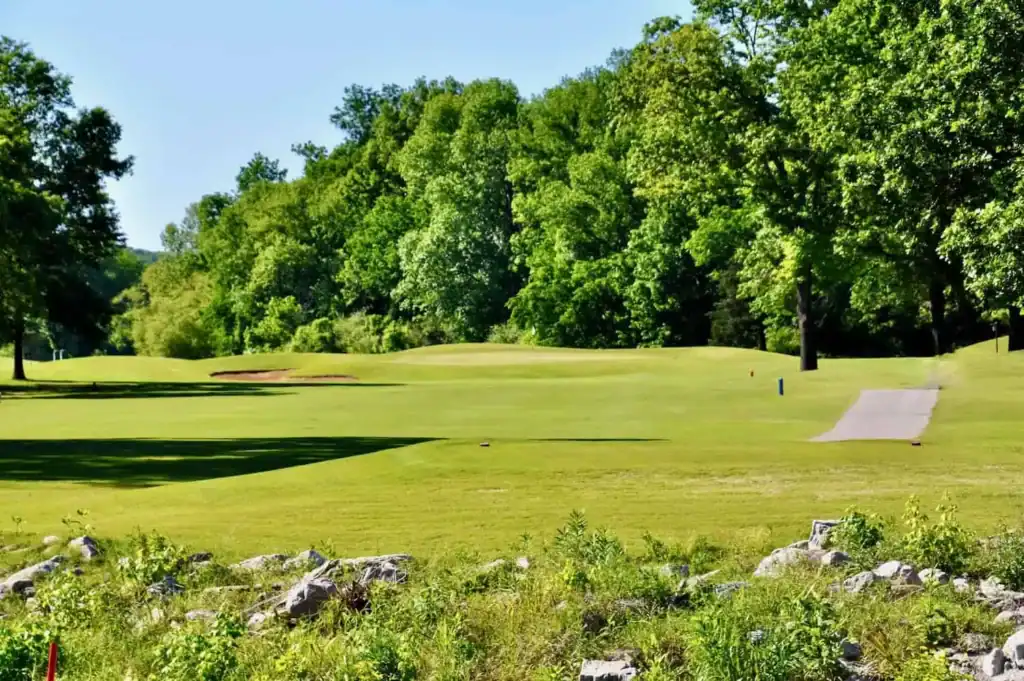
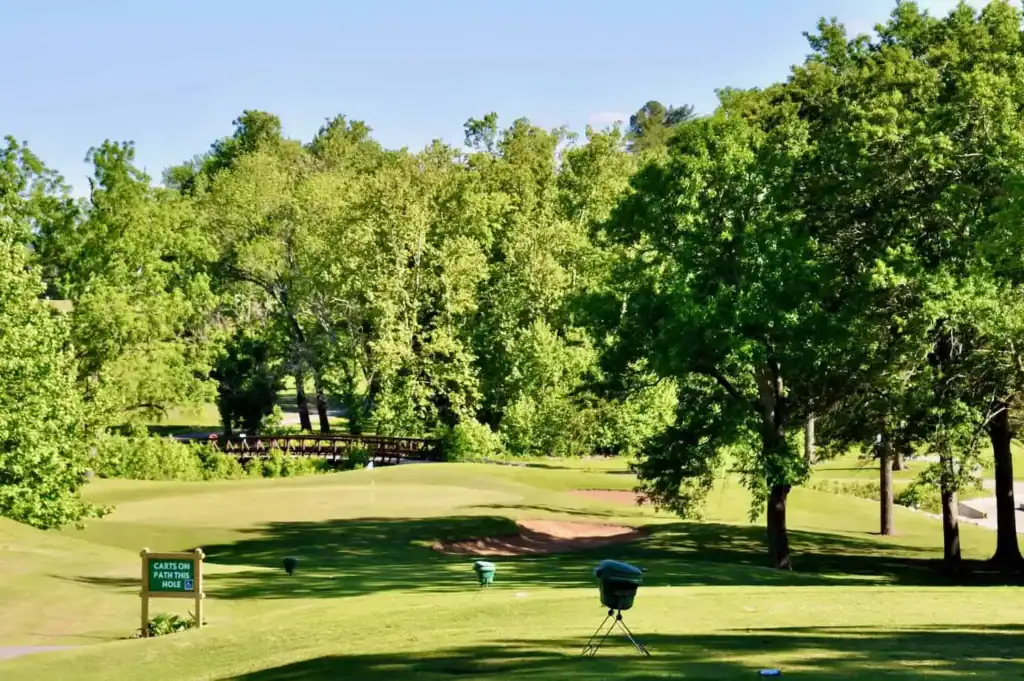
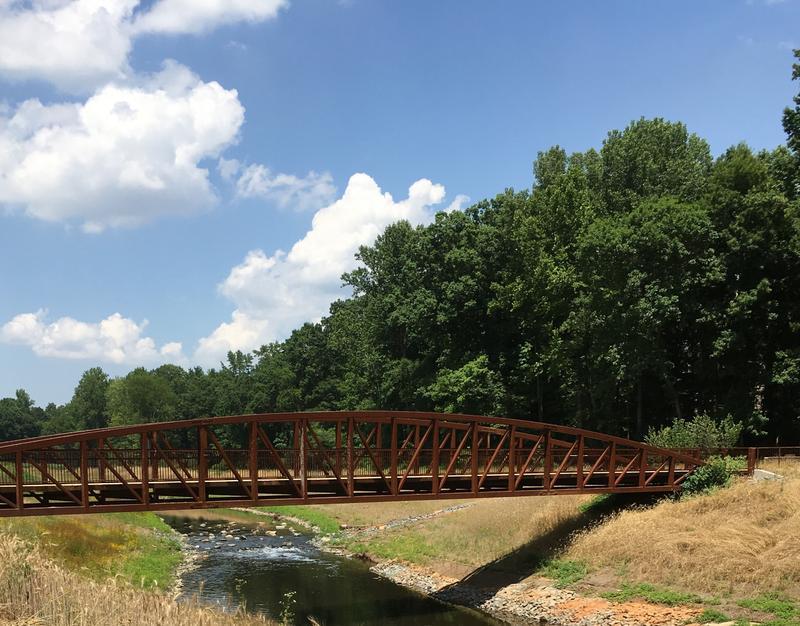
Rountree walked the valley ground with Finger, reading the land, understanding where the creek wanted to go and where the fairways should follow. The course they built runs through the same Little Sugar Creek valley where the Linebarger’s’ nine holes had once run. The same creek, the same morning light, the same Ozark ground, now grown to eighteen holes. Little Sugar Creek winds throughout the eighteen holes, coming into play on both nines. The creek that had watered this valley for thousands of years now winds through the round of golf the way a good story winds through its own telling, always there, coming into play when you least expect it.
Cooper then hired E. Fay Jones, protégé of Frank Lloyd Wright, to design the clubhouse. Jones set the building into a slope overlooking the course, composing it as a series of linked gabled pavilions, stone piers alternating with floor-to-ceiling glass windows shaded by deep eaves. In its horizontality and use of natural materials, the building appears to grow out of its site. He designed it so that from anywhere inside you are always aware of the course. The landscape is always in the room with you.
The Bella Vista Country Club served its first meals on Thanksgiving Day, November 28, 1968. The golf talk at those tables was the same talk that had run long over white tablecloths in this valley for forty years, only now the men were retired and had every morning free.
Meanwhile, up on Sunset Mountain, the old hotel had found its last purpose. Cooper remodeled the Sunset into offices for his company, naming it Village Hall. The lobby where the stone fireplace still stood became a sales floor. The dining room where the orchestra had played became the place where retirement lots were sold to couples from Kansas City and Dallas who drove up the same road, stopped at the same view, and felt exactly what the Linebarger’s had always known they would feel.
The country club in the valley handled the living. The old hotel on the mountain handled the selling. Together they were the whole story of Bella Vista told twice, once in the language of 1929 and once in the language of 1968, both saying the same thing.
Come here. Stay. You deserve this valley.
Cooper co-hosted the National Coaches Invitational Tournament with Arkansas head football coach Frank Broyles, and upon completion of the Bella Vista Country Club in 1968, the tournament moved to Bella Vista in 1969. By 1970 it was the official invitational tournament of the American Football Coaches Association. Coaches from the great football programs of America walked the same holes that retired schoolteachers from Kansas City played every morning before breakfast. The valley the Linebarger’s had spent thirty years putting on the map was being put on a different kind of map entirely.
What grew from those eighteen holes is something the Linebarger brothers could not have fully imagined, though they would have recognized every impulse behind it. Cooper built six new lakes and seven golf courses. The community gathered around them grew from a few thousand souls to thirty thousand. The Property Owners Association formed in 1965 under the name, fittingly, the Bella Vista Country Club, the golf course Cooper called the very center of the development giving its name to the entire community golf built.
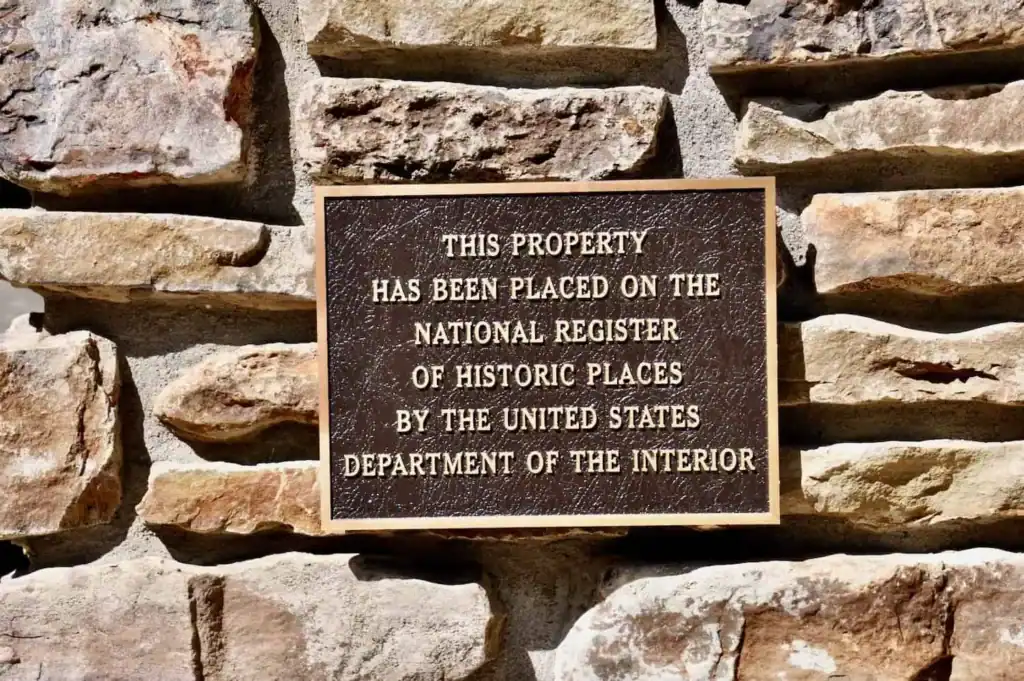
The old Sunset Hotel, listed on the National Register of Historic Places in 1991, was emptied in 1992. It stood vacant on its hill, stone fireplace still there, the view unchanged. Then in July of 1999 someone set it on fire in the dark and by the time anyone noticed the Sunset Hotel had burned to the ground.
What remains is the foundation.
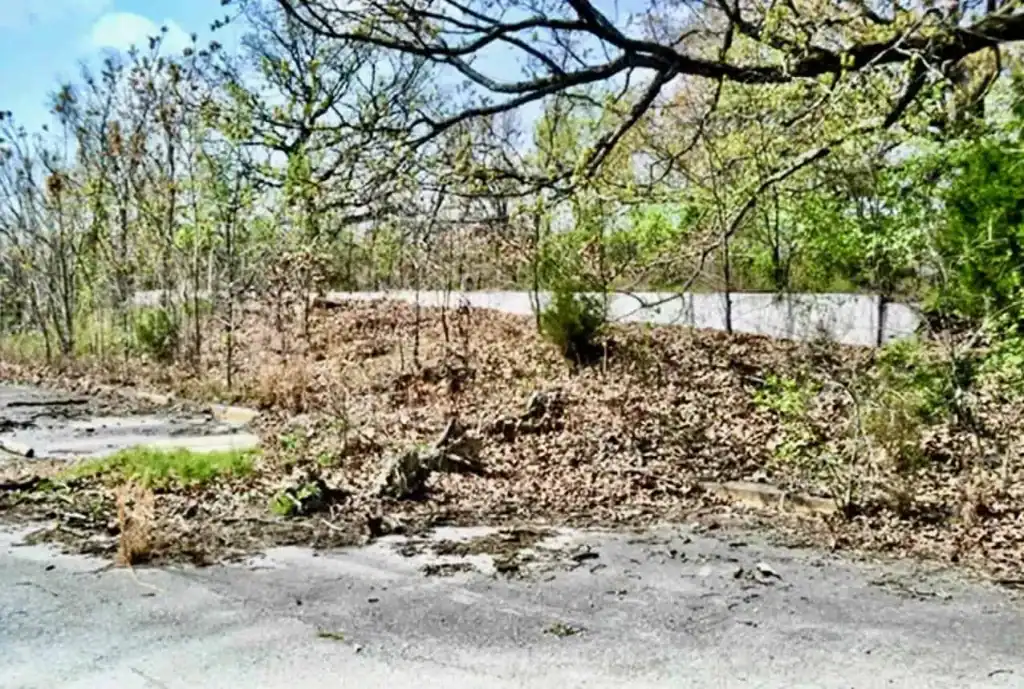
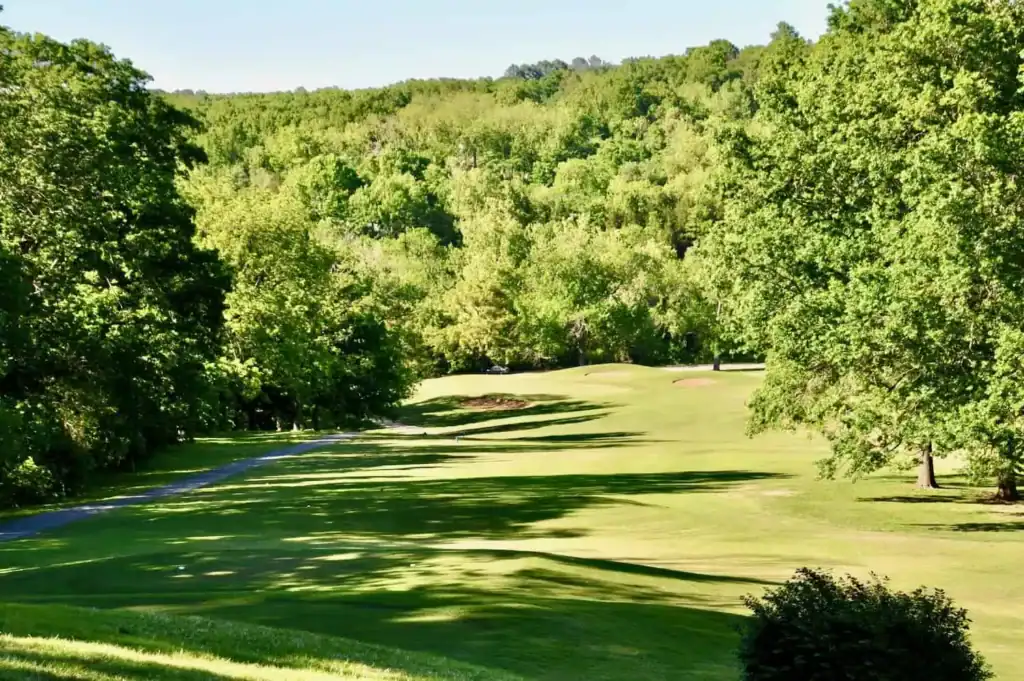
Native stone, still rises from the hillside as though the building simply stepped away and left its bones. Down in the valley the Bella Vista Country Club course still plays its eighteen holes through the same ground where nine simpler holes once ran in 1921. Long narrow fairways flanked by mature trees, several holes where Little Sugar Creek comes into play, a course that never seems to play the same way twice.
The same creek. The same valley floor where Harold stood at a window above on a July evening in 1929 and felt something unknot in him that had been knotted longer than he knew. The E. Fay Jones clubhouse sits on its hillside above those fairways, still looking out over the course the way the Sunset Hotel once looked out over the valley that made it necessary.

Two buildings. Two architects. Two eras. The same understanding that in this valley in northwest Arkansas the landscape was never the backdrop.
It was always the point.
The Linebarger’s built nine holes beside a lake in 1921 because they understood what people needed. They built a hotel on a mountain in 1929 to look down over those fairways because they understood it twice. Cooper built eighteen holes through the same valley in 1967 because he understood it as well.
The Sunset Hotel is gone.
The fairways remain.
Little Sugar Creek winds through them still, coming into play when you least expect it, entirely unconcerned with how long it has been doing so.
It will be there long after the last scorecard has been signed.
Continue Your Golf Journey
Every golf course has a story waiting to be discovered. As an Enthusiast, you’ll unlock exclusive access to our growing collection of golf course reviews, hidden gems, historic fairways, travel inspiration, and unforgettable golf adventures from around the world.
Join today and start exploring the stories behind the world’s most memorable courses.