
The Eight Limbs of Yoga and the Game of Golf
Yama, Niyama, Asana, Pranayama, Pratyahara, Dharna, Dhyana, Samadhi.
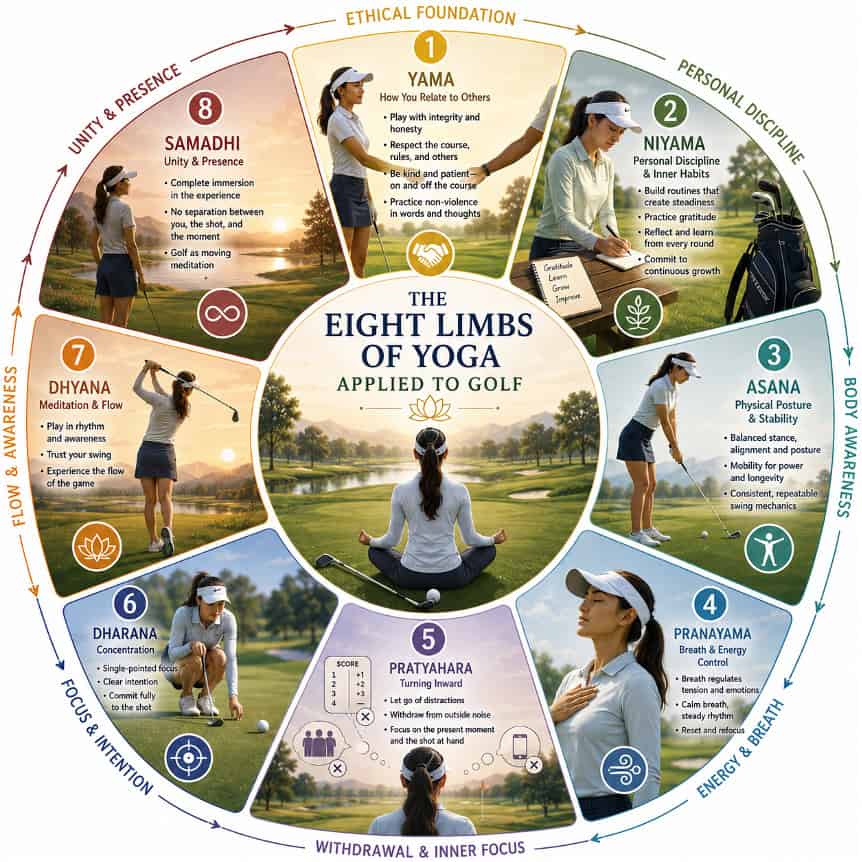
The Eight Limbs of Yoga: Yama, Niyama, Asana, Pranayama, Pratyahara, Dharana, Dhyana, and Samadhi,form the foundation of the yogic sage Patanjali’s Yoga Sutras. This ancient framework offers a path toward self-understanding and liberation from the habits, fears, and patterns that hold us back. When applied to golf, these eight limbs become a powerful guide for uncovering your truest, most capable self on the course.
Up your on-the-course skills with these essential off-the-course guides.
Not a member an Associate or Concierge member yet?
Explore your options here AMW Memberships
1. Yama

The Yamas, meaning “restraint” or “reigning in”, are the first part of the Eight Limbs of Yoga. To be conscious of our thoughts and actions whether in the game of golf, or in life, is integral to being the golfer and person you want to be. Being acutely aware of what you think and how you respond to situations helps you make the best decisions.
Understanding how to refrain from reacting will help you improve your self-control after a poor shot, set your sights for the next shot, and play the game to your best ability.
2. Niyama

The Niyamas are the second limb of Patanjali’s ‘Eight Limbs of Yoga’. They refer to the duties directed towards ourselves.
The Niyamas refer to duties directed towards ourselves – inner observances. They are intended to help us build character. When we work with the Niyamas – from Saucha (cleanliness) to Isvarar Pranidhana (surrender to a higher power) – we’re guided from the grossest aspects of ourselves to the truth deep within.
3. Asana

Asana is one of the eight limbs of classical Yoga and states that poses should be steady and comfortable, firm yet relaxed. The yoga asanas gently encourage us to become more aware of our body, mind, and environment.
4. Prananyama

In yoga, as in life, breathing can be taken for granted. It’s something we do automatically, involuntarily, and unconsciously. But since ancient times, practitioners of yoga have understood that breath is life. This awareness is expressed in the Sanskrit term pranayama, which is commonly translated as “breath control.”
5. Pratyahara

The fifth step or limb is called pratyahara and is defined as “the conscious withdrawal of energy from the senses.” Almost without exception yoga students are puzzled by this limb. We seem to inherently understand the basic ethical teachings like satya (the practice of truthfulness), and the basic physical teachings like asana (the practice of posture), and pranayama (the use of breath to affect the mind). But for most of us the practice of pratyahara remains elusive.
6. Dharna

Dharana or Concentration is the sixth limb of Ashtanga Yoga. It refers to concentration of the mind by fixing the mind on a particular object. This could be concentration on an external object such as a symbol, deity, image, or even the sun or moon. Internal concentration could be on a mantra or a chakra.
7. Dhyana

Dhyana is a state of being. It’s a connection to pure consciousness rather than an effort that needs to be made. In fact, it is the absence of effort.
8. Samadhi

Samadhi is a state of profound and utterly absorptive contemplation of the Absolute that is undisturbed by desire, anger, or any other ego-generated thought or emotion. It is a state of joyful calm, or even of rapture and beatitude, in which one maintains one’s full mental alertness
Accessing the Vault
Are you interested in taking your game to the
next level? Please join as an Associate to get
your exclusive code to break into the Vault.